Temple Epoxy Flooring installs polyaspartic floor coating systems across Temple, TX, serving surrounding cities including Belton, Harker Heights, Killeen, Nolanville and Copperas Cove. We use polyaspartic and polyurea as wear layers over epoxy builds and, where the slab suits it, as complete fast-cure systems that return a floor to service the same day.
Polyaspartic arrived in this trade as a solution to two specific problems: epoxy takes days to cure, and epoxy ambers under sunlight. It solves both convincingly. What it does not do is remove the need for preparation, and a fast-cure product over an unprepared slab fails faster than a slow one, not slower.
So we treat it as a chemistry with a job rather than as an upgrade to sell. On some floors it is clearly the right answer. On others an epoxy build with a polyaspartic topcoat gives a better result for less money, and we will say so.
What Polyaspartic Actually Is
An Aliphatic Polyurea
Polyaspartic is a subset of polyurea chemistry, formulated so the reaction can be slowed enough to be laid by hand rather than sprayed by machine. Being aliphatic is what gives it UV stability. Being a polyurea is what gives it the cure speed and the toughness, and both properties come from the same family of resins.
How It Differs From Epoxy
Epoxy is a high-build, hard, strongly adhering resin that cures slowly and ambers in sunlight. Polyaspartic goes down thinner, cures in hours rather than days, holds color, and retains more flexibility. Where epoxy provides body and bond, polyaspartic provides speed, color stability and abrasion resistance at the wear surface.
Where the Two Get Combined
Most residential floors we install are hybrids: an epoxy primer and build coat carrying the flake or aggregate, with one or two polyaspartic clear coats over the top. That sequence puts each product where it performs best. Using a single chemistry for the whole system almost always means accepting a compromise at one end or the other.
Why Cure Speed Matters Here
Same-Day Return to Service
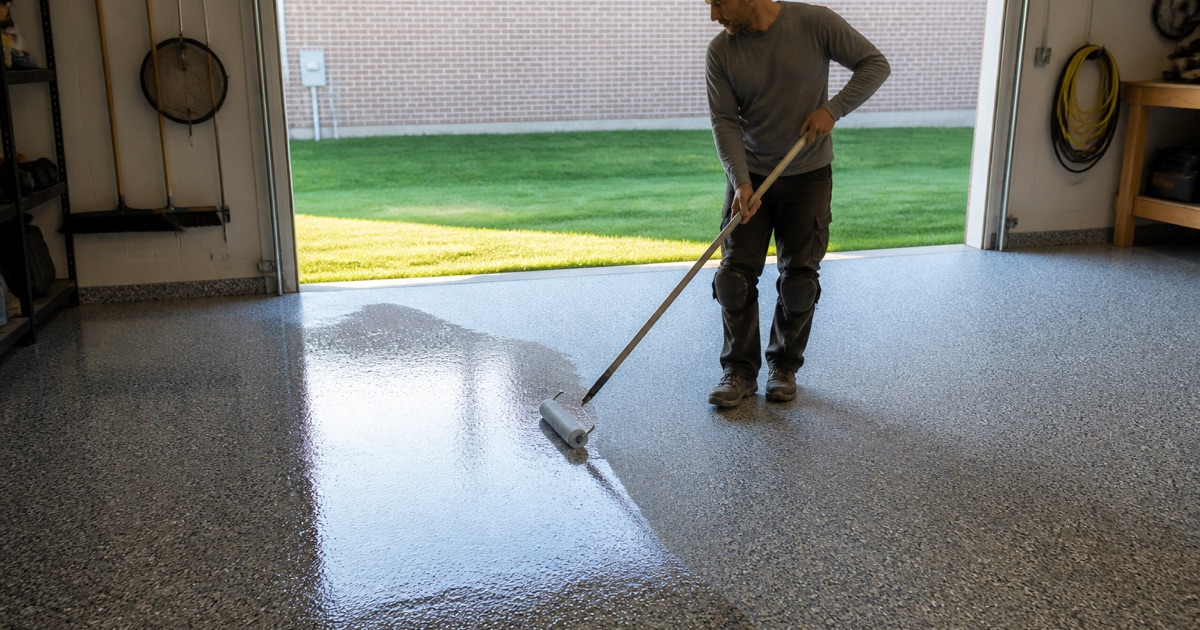
On a suitable slab the whole sequence — grind, prime, broadcast, scrape, topcoat — fits inside a working day, with foot traffic that evening and vehicles within a day or two. For a business that cannot close, or a household with nowhere else to put the contents of a garage, that compression is often worth more than the material saving of a slower system.
Commercial Work Outside Business Hours
Fast cure is what makes overnight and weekend installs realistic. A retail unit, a clinic or a service bay can be coated after closing and be back in use when it opens. We phase the work by section and contain the area, and the cure schedule is what determines how much floor we can open in one visit.
The Short Recoat Window
Speed cuts both ways. Polyaspartic has a maximum recoat time as well as a minimum, and it is measured in hours rather than days. Miss it and the next coat cannot bond chemically, forcing an abrasion step. That window narrows further on a hot slab, which is why the schedule is built around the concrete rather than the crew’s convenience.
Working Time on a Hot Slab
Pot life shortens sharply with temperature and polyaspartic starts short. On a slab that has been in the Texas sun, working time can collapse to a few minutes. We mix small, place people deliberately and open limited areas at a time. This is the main reason a polyaspartic install goes wrong, and it is a discipline problem rather than a product one.
Where Polyaspartic Earns Its Cost
Sunlit Garages and Open Doors
A garage that spends its afternoons with the door open gets a genuine UV dose across the front third of the floor. An epoxy topcoat will amber there and leave a visible line where the sunlight stops. An aliphatic topcoat holds its color evenly across the whole floor, which is the difference between a floor that ages and one that looks patchy.
Exterior and Semi-Exterior Slabs
Patios, covered walkways, entry aprons and anything else outdoors need UV stability as a baseline rather than an upgrade. Polyaspartic also handles thermal cycling better than a rigid epoxy, which matters on an exterior slab that heats and cools through a wide daily range for most of the year.
Cold-Weather Installation
Most epoxies slow dramatically as the slab cools and some stop curing altogether below their minimum. Polyaspartic keeps working at substantially lower temperatures. Temple averages around thirty-three freezing nights a year, and the shoulder weeks either side of the cold season are exactly when this advantage keeps a schedule moving instead of stalling it.
The median last freezing night here falls in mid-March and the first in late November, so the risky periods sit at the edges of winter rather than in the middle of it. Those are the weeks that catch people out, because the daytime conditions look workable and the overnight low undoes the day’s work on a slab that has not yet reached strength.
Hot Tire Resistance
Warm tires soften weaker films and then lift them as the vehicle cools, leaving patches shaped like the tread. A properly built system with a polyaspartic wear layer resists this far better than a thin epoxy or a one-part paint. It is one of the most common reasons a homeowner calls us to replace a floor that is only a couple of years old.
Preparation Does Not Change
Mechanical Profile
Every slab is ground or shot blasted to an ICRI CSP profile before anything is applied. Fast cure makes preparation more important rather than less, because a product that sets in minutes gives no time for it to find its way into a marginal surface. There is no version of this work where etching substitutes for grinding.
Moisture Testing
We test older slabs to ASTM F1869 or ASTM F2170 against ASTM F710 thresholds before ordering material. A fast topcoat does nothing about vapor pressure from below, and a floor that blisters in three months is no better for having been installed in a day. Where readings are high we specify a moisture-mitigation primer under the system.
Cracks and Joints
Polyaspartic is slightly more flexible than epoxy and that is a real property, but it is not enough to bridge a moving crack. On the reactive clay soils around Temple a live crack is detailed as a joint with a semi-rigid polyurea filler and disclosed as something that may reappear. No coating changes what the ground underneath is doing.
Slab Temperature at Application
We measure the slab, not the air. The working rule is that the surface must sit at least five degrees above the dew point, and on a humid Central Texas morning the concrete is often the coldest thing in the room. Coating over invisible condensation is an adhesion failure that shows up weeks later, and it is entirely avoidable by waiting a few hours.
- 20+ Years in Central Texas
- Fully Insured
- Free Written Proposal