
Temple Epoxy Flooring installs polished concrete flooring across Temple, TX, serving surrounding cities including Belton, Killeen, Harker Heights, Woodway and Hewitt. We grind, densify and refine existing slabs into a finished floor for retail units, warehouses, offices, restaurants and an increasing number of houses, and we have been doing it in this region for more than twenty years.
Polished concrete is the one thing we install that is not a coating. There is no film, no primer and no bond line, because the finished surface is the slab itself, cut back and refined until it takes a sheen. That single structural difference removes most of the failure modes this trade is known for. Nothing can delaminate when nothing has been laid on top.
What it does instead is expose everything. Polishing shows the pour, the patches, the trowel history and the aggregate, so the honest conversation happens before we start rather than after. We assess the slab, tell you what it is likely to look like, and say plainly when a floor is not a good candidate.
What Polishing Actually Is
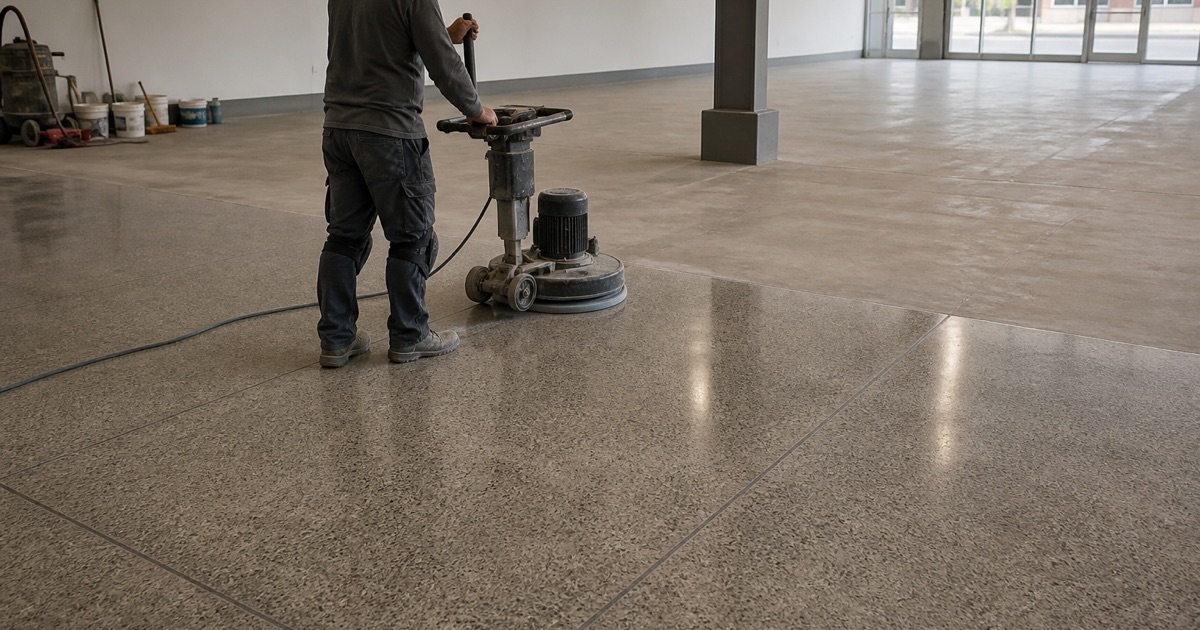
A Mechanical Process, Not a Product
The floor is worked through a sequence of progressively finer diamond abrasives, starting with metal-bonded segments that cut and moving into resin-bonded pads that refine. Each pass removes the scratch pattern left by the one before it. The sheen at the end is not a substance added to the floor; it is what concrete does when it is refined finely enough.
The Grit Sequence
Skipping steps is the most common way a polished floor goes wrong, because a coarse scratch left in the surface will still be visible under a high sheen and cannot be removed later without going back several stages. We work the full sequence in order. It is slower, and it is the difference between a floor with genuine depth and one that looks hazy under raking light.
Densification
Partway through the sequence we apply a lithium silicate densifier, which reacts with free lime inside the concrete to form additional hardened material within the pore structure. This is what allows a soft or dusty slab to take and hold a polish. It works inside the concrete rather than on it, so there is no layer that can later separate.
Guarding and Protection
A penetrating stain guard is applied at the end on most commercial floors. It occupies the pores near the surface and slows the absorption of oil, food and spills without forming a film. It needs reapplying periodically, which we set out in the handover rather than leaving you to discover when the first stain does not lift.
Choosing Exposure and Sheen
Cream Finish
The shallowest cut removes only the top surface, leaving the cement-rich cream layer largely intact and showing little or no stone. It gives the most uniform appearance and is the most forgiving of a slab with variable aggregate, so it suits floors where consistency matters more than showing off the concrete.
Salt-and-Pepper
Cutting slightly deeper removes the cream and reveals the fine aggregate in an even speckle across the floor. This is the most commonly specified exposure and generally the best balance: it looks deliberate, it hides ordinary soiling well, and it does not demand the flawless pour that a full aggregate exposure does.
Full Aggregate Exposure
The deepest cut reveals the large stone and produces a floor closer to terrazzo in appearance. It is the most striking option and the least forgiving, because it exposes any variation in how the slab was poured, placed or patched. It also costs more, since it is simply more grinding through harder material.
Gloss Level
Sheen is set by where the resin sequence stops. A matte or satin floor reads as understated and hides dust better; a high-gloss floor gives real reflectivity and makes a space feel considerably brighter. We agree it from physical samples on your own slab where possible, because ambient light changes the result more than most people expect.
Where Polished Concrete Works Best
Warehouse and Distribution Floors
A densified polished slab stands up well to forklift and pallet traffic, cleans easily, and reflects enough light to noticeably reduce the lighting load in a tall building. There is no coating to be gouged off by a dropped pallet, and localized damage can usually be re-polished rather than requiring a whole bay to be recoated.
Retail and Hospitality
Polished concrete suits retail units, showrooms, bars and restaurant floors where a hard-wearing surface has to look intentional. It takes heavy foot traffic without showing traffic lanes the way a resilient floor does, and it removes the ongoing cost of stripping and resealing that a vinyl or waxed floor carries.
Offices and Institutional Spaces
In offices, clinics and public buildings the appeal is durability with almost no maintenance overhead beyond routine cleaning. There is nothing to lift at the edges, nothing to curl and no seams. Where acoustics or comfort underfoot matter, polished concrete is usually combined with rugs or acoustic treatment rather than ruled out.
Residential Floors
Polished slabs are increasingly popular in houses, particularly in open-plan living areas and in new builds where the slab was placed with polishing in mind. In an existing house the constraint is usually what is currently stuck to the concrete and what condition it left behind, which we establish before quoting rather than after lifting the old floor.
What We Check Before Quoting
Slab Soundness and Flatness
Polishing follows the plane of the existing slab, so a floor with significant dips and high spots will still have them afterwards, and the grinder will cut the high areas deeper and expose more aggregate there. We check flatness and tell you where the result will vary. Where it matters, a self-leveling layer may be the better route than polishing what is there.
Existing Coatings and Adhesives
Old coatings, tile adhesive, carpet glue and mastic all have to come off, and some of them fight back. We use PCD tooling to shear stubborn material away before starting the diamond sequence. This is often the largest single variable in the price, which is why we want to see under the existing floor before committing to a figure.
Patches, Repairs and Service Penetrations
Anything previously patched will read differently from the surrounding slab once polished, because the patch material and the original concrete refine differently. Old plumbing trenches and filled penetrations show clearly. We map them in advance and agree whether to accept them as part of the character or to treat the floor another way.
Slab Hardness
Concrete strength decides which diamond bond we start with, and the rule is counterintuitive: hard concrete takes a soft bond so the matrix wears fast enough to keep exposing fresh diamond, while soft concrete takes a hard one. Getting it wrong either polishes without cutting or destroys tooling at cost. We test rather than guess.
Moisture, Movement and Central Texas Ground
Why Moisture Is Less Critical Here
Because there is no film on the surface, vapor rising through the slab has somewhere to go, so polished concrete is far more tolerant of a damp slab than any coating is. That makes it a genuinely useful option on floors where moisture readings have ruled out a resin system, and it is one of the first alternatives we suggest when testing comes back high.
What Polishing Still Cannot Do
Polishing does not stop ground movement any more than a coating does. On the heavier clay soils around Temple a live crack will keep working and will remain visible in a polished floor, where the high sheen can make it more noticeable rather than less. We identify live cracks during assessment and agree how they are treated before any diamond touches the slab.
Joints in a Polished Floor
Existing control joints stay, and they are usually filled with a semi-rigid polyurea that supports the joint edges against hard-wheeled traffic while still accepting movement. Filling a moving joint rigidly, or ignoring it in a warehouse, produces spalled edges within a year. How the joints are handled is a large part of how long a polished industrial floor stays looking finished.
- 20+ Years in Central Texas
- Fully Insured
- Free Written Proposal