Temple Epoxy Flooring installs concrete driveway coating systems across Temple, TX, serving surrounding cities including Belton, Harker Heights, Nolanville, Woodway and Salado. We coat driveways, aprons, parking pads and carport slabs with UV-stable, textured systems built for vehicle traffic in full sun, and we have been working exterior concrete in this region for more than twenty years.
A driveway is the hardest exterior surface we coat, and the reason is the combination rather than any single factor. It takes the full solar load with no shade, thermal cycling every day of the year, hot tires parking on it, oil and fuel drips, and rainwater running across it. Most coatings sold for concrete were never designed for all of that at once.
That is why the two most common failures we are called to look at are ambering and hot tire pickup, and both are specification errors rather than bad luck. An interior-grade product put outdoors will do exactly this, on schedule.
Built for Sun and Vehicles
UV Stability Is Not Optional
Epoxy ambers under sustained ultraviolet light, turning visibly yellow and losing depth. Outdoors that is not a slow cosmetic drift, it is the defining failure of the wrong specification. We use aliphatic polyaspartic or polyurea as the exposed layer on every driveway, keeping epoxy for the build coat underneath where sunlight never reaches it.
Hot Tire Pickup
Warm tires soften a weak or poorly bonded film and then lift it as the vehicle cools, leaving patches shaped like the tread. A driveway sees this every day in summer. Resistance comes from a properly ground and profiled slab, adequate build thickness and a topcoat formulated for it, in that order of importance.
Thermal Cycling
An exterior slab expands and contracts through a wide daily range for most of the year, and the coating has to move with it without cracking or debonding. This is where a slightly more flexible polyaspartic outperforms a rigid high-build epoxy, and it is another reason interior specifications transplanted outdoors have a short life.
Surface Temperature at Install
An unshaded slab in Texas sun runs far hotter than the air above it, and Temple sees around twenty days a year at or above a hundred degrees. High surface temperature collapses working time, can flash a film before it wets out properly, and raises the risk of pinholing as air pushes out of warming concrete. We work exterior slabs to the surface temperature, not the forecast.
Traction and Texture
Slope Changes the Requirement
Most driveways slope, and a smooth coating on a wet slope is genuinely hazardous. Texture is therefore part of the specification rather than an option, and we increase it on steeper falls. This is one of the few places we will argue against a customer’s preference, because the smooth finish that looks best dry is the one that becomes a problem in the first rain.
Aggregate Selection
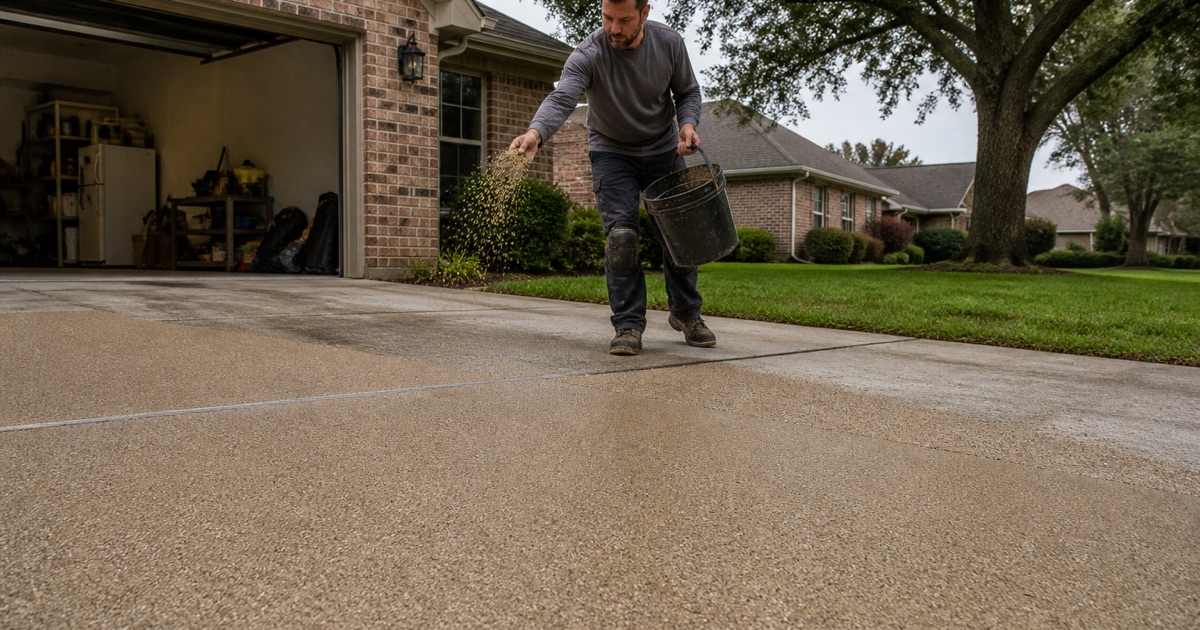
A broadcast aggregate gives durable traction that is part of the system rather than a surface treatment that wears off. Grade is chosen against the slope, how the driveway is used and whether people walk on it barefoot between a pool and a house. Coarser is not automatically better, since an aggressive texture holds dirt and is harder to sweep.
The Street Transition and Apron
Where the driveway meets the street the slab usually changes, often with a joint, a level difference and a different concrete age either side. That transition takes the most turning traffic on the whole driveway. We detail the edge and the joint deliberately rather than running the coating across and letting the traffic find the weakness.
Slab Condition and Movement
Preparation Outdoors
Exterior concrete carries decades of oil, sealers, road grime and previous treatments, all of which interfere with bond. We grind or shot blast to a measurable ICRI CSP profile rather than pressure washing and hoping. Preparation matters more outdoors than inside, because the finished surface faces conditions no interior floor ever sees.
Cracks Over Reactive Ground
Parts of this area sit on clay that swells and shrinks seasonally, and a driveway is a large, thin, unreinforced-feeling slab spanning it. Dormant cracks are prepared and filled. Live ones are treated as joints and disclosed, because a coating is a film that follows the concrete and no product bridges ground movement.
Existing Joints
Control and expansion joints are carried through the coating rather than filled solid and covered. A coating bridged rigidly across a working joint cracks along a line of its own choosing, which is invariably less tidy than the joint the original slab was given. Honoring them keeps the movement where it was designed to go.
Freeze and Surface Damage
Temple averages around thirty-three freezing nights a year, enough to drive surface damage where water sits in already-porous concrete. Where we find spalling in a low spot we look at drainage as part of the job, since a new coating over standing water fails in the same place for the same reason as the surface it replaced.
The risky periods sit at the shoulders of the cold season rather than in the middle, with the median last freezing night in mid-March and the first in late November. Those are the weeks that catch an install out, because the working day looks perfectly warm and the overnight low reaches a slab that has not yet developed strength.
- 20+ Years in Central Texas
- Fully Insured
- Free Written Proposal